
How to Charge an Electric Scooter
A clear, model-first charging routine—with verified charging times, safer battery advice and a calculator that doesn't guess what charger your scooter uses.
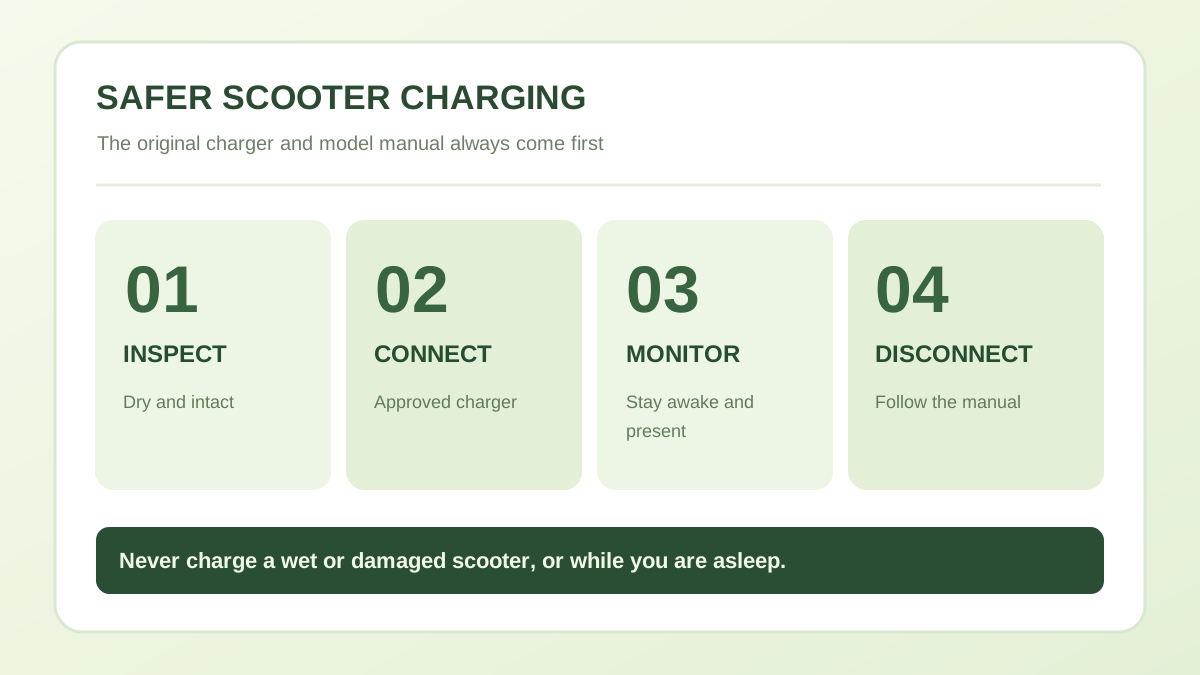
How do you charge an electric scooter safely?
Turn off the scooter if its manual requires it, allow an overheated or very cold pack to return to the permitted charging temperature, then check that the port and approved charger are dry and undamaged. Follow your specific manufacturer's connection order, charge in a clear dry area while you are awake and present, and disconnect as directed when charging completes. Never charge while sleeping, use an unapproved “universal” charger, or charge a damaged or wet battery. The CPSC recommends supervised charging.
How to Charge Your Electric Scooter: 6 Safe Steps
Some guides insist that every charger must connect to the wall first. That is not a universal instruction: the correct plug-in and unplugging sequence is the one in your scooter's manual. Follow these checks before and during each charge.
Use the supplied or maker-approved charger
Check the approved charger model and connector in your manual. A plug that fits another scooter does not guarantee voltage, current, polarity or battery-management compatibility.
Cool down and inspect
Let a hot pack return to the permitted charging temperature. Make sure the charging port, charger and connector are dry, intact and free of visible debris or corrosion. If water may have entered the pack, do not connect power.
Choose a safer charging location
Use a stable, dry, ventilated location away from heat sources and combustible materials. Keep exits and stairways clear. Do not cover the scooter or charger.
Connect in the manufacturer's specified order
With the scooter in the state required by its manual, connect the approved charger exactly as directed. Different makers and models may specify different connection order or charge-port procedures.
Stay present; check the manufacturer's full indicator
Stay awake and nearby. Follow the indicator or app instructions for your model; don't assume red and green lights mean precisely the same thing on every charger.
Disconnect when charging finishes
Unplug according to the manual. CPSC recommends disconnecting the charger when the charge cycle is complete; don't leave it charging unattended or overnight while asleep.
How Long Does It Take to Charge an Electric Scooter?
Charging time varies substantially. Compare exact models, not a generic “all scooters take 4–6 hours” claim. These numbers come from manufacturer product pages or manuals, not timed charging tests by TheScooterist.
Segway Ninebot MAX G2 (US manual)
~6 hr551 Wh lithium-ion battery · built-in 121.8 W DC output · manufacturer manual
Segway MAX G2 product manualRazor E300HD
Up to 12 hrManufacturer's rechargeable lead-acid battery instructions; the manual also gives a recommended maximum charging time of 24 hours. Unlike lithium-ion models, follow Razor's specific procedure.
Razor E300HD owner manualThe NIU KQi2 Pro has lower Wh than the KQi3 Pro but a longer published charge time—strong evidence that capacity alone does not establish charging duration. Razor lead-acid charging should never be modeled with the lithium-ion calculator below.
Estimate Your Own Charging Time
Use the approved charger's DC output (watts), rather than the wattage printed for input from the wall. For a 42 V × 2.9 A charger, the stated maximum output is 121.8 W. The tool separates a simple ideal minimum from an illustrative allowance for charge taper.
Electric Scooter Charging-Time Calculator
Use your battery's watt-hours and the approved charger's DC output watts. The result is a planning estimate, not a promised finish time.
Estimated time with your selected 30% allowance
A lithium-ion pack charges more slowly near full. Charger wattage is a maximum output, not a continuous guarantee. Battery temperature, pack controls and charging losses affect actual duration.
Planning formula: battery Wh × (target − current)% ÷ approved charger DC watts × (1 + user-selected allowance). This is a simplified illustration, not a tested charge curve, clock deadline or advice to use a different charger. It is intended for lithium-ion scooter packs; it does not model lead-acid scooter charging, such as the Razor E300. Follow the manufacturer’s published charging time and safety instructions.
Battery Wh, Charger Watts and Why Charging Slows Down
A battery's watt-hours (Wh) measure its nominal energy storage. Charger output power is measured in watts (W). For a rough minimum charging-time calculation, divide the battery energy you want to add by the rated DC power output. When charging lithium-ion cells, the pack's electronics generally reduce charging current as the battery approaches full. Real time also depends on temperature, system behavior and charger efficiency.
That is an idealized constant-power figure, not a reliable time-to-100%. It excludes charge taper and other losses. The calculator's adjustable allowance is only for planning.
The manufacturer's stated full charge time remains the better reference for an exact model. Do not assume a high-power charger is approved merely because the theoretical time is shorter. Faster charging can require different electronics, cabling and thermal safeguards.
What Do Red and Green Charger Lights Mean?
Many modern scooter chargers use red for charging and green for full or standby, but meanings differ by model. A green LED when the battery gauge is still low does not necessarily mean the pack is healthy. It may also mean no current is flowing due to a loose connection or a protective shutoff.
Red light
Often indicates active charging; verify with the manual.
Green light
Can mean fully charged or charger idle. A green light alone cannot confirm battery condition.
No light / flashing
Check the specific fault-code guidance; never open the charger or battery to test it.
If the charger stays green while the dashboard shows an empty battery, start with our electric scooter not-charging diagnostic guide. Do not force a charge or “reset” the pack by bypassing the battery-management system.
Where and When Should You Charge an E-Scooter?
Never while asleep or away
CPSC advises being present and awake while charging. An overnight charging plan is not safe just because charging takes many hours.
Keep your escape route clear
Do not put the scooter in hallways, stairways, near doors or other emergency exits.
Do not charge a wet pack or port
Water can cause shorts or corrosion. Our rain and IP-rating guide explains what to do after water exposure.
Watch for battery warning signs
Swelling, hissing, unusual odor, smoke, excessive heat and leakage are signs to stop use. Move away from a smoking or burning battery and call emergency services.
The UK government battery-safety guidance also advises letting an overheated battery cool, keeping chargers uncovered, and charging away from flammable materials.
Should You Charge Every Day or Always to 100%?
There is no universal battery-percentage rule for every scooter. Partial charging may reduce stress on some lithium-ion packs, but your manufacturer's battery management, minimum permitted charge, storage instructions and desired riding range matter. You can charge more frequently without each plug-in automatically counting as one entire charge cycle.
For a deeper explanation of cycles, degradation, storage and battery-health warning signs, see our electric scooter battery-life calculator and guide. To calculate the electricity bill rather than the time, visit the cost of charging an electric scooter.
Electric Scooter Charging FAQs
How long should an electric scooter charge?
Use the exact model's manufacturer time. Examples include 6 hours for NIU KQi3 Pro, about 6 hours for Segway MAX G2, and up to 12 hours for the Razor E300HD. Actual times may differ with charge level, temperature and battery condition.
Can I leave my electric scooter charging overnight?
No. CPSC advises staying present and awake during charging and unplugging when complete. Don't charge while asleep, even if the scooter has an automatic cutoff.
Should the wall plug or scooter plug connect first?
Follow the connection and disconnection order in the manual for your exact scooter and charger. There is no safe universal sequence that overrides a model's instructions.
Can I charge with a universal charger?
Use only the charger supplied or explicitly approved by the scooter manufacturer. CPSC warns that generic universal chargers can be incompatible even when their connector fits.
How long does a Razor E300 take to charge?
The Razor E300HD manufacturer manual says recharge can take up to 12 hours even if its LED turns green first. Verify the manual for your specific Razor variant, not a lithium-ion scooter guideline.
Does a green charger light mean the battery is full?
Often, but not always. Green can also indicate standby or a fault-related lack of current. Check your model's charger guide and battery level.
Can I charge a wet electric scooter?
Do not charge a wet charging port, charger or suspect battery. If water may have entered electrical components, stop use and obtain qualified service.
Why is my scooter taking longer than the manual says?
Factors can include lower starting charge, temperature limits, aging batteries, charger faults or battery-management behavior. Never substitute an unapproved higher-power charger. Use qualified troubleshooting for unusual symptoms.
How do I convert amp-hours into watt-hours?
Battery nominal Wh is approximately nominal battery voltage × rated amp-hours (Ah). For example, 36 V × 10 Ah is approximately 360 Wh. Do not confuse battery nominal voltage with a charger’s maximum charging voltage.
Keep the rest of the scooter safe, too: use the electric scooter maintenance checklist to check tires, brakes, folding mechanisms and battery warning signs.