
Electric Scooter Battery Life
How long will a battery last in years, full charges, and miles? Those are three different questions. Here's how to answer each—and what to look for before replacing a pack.
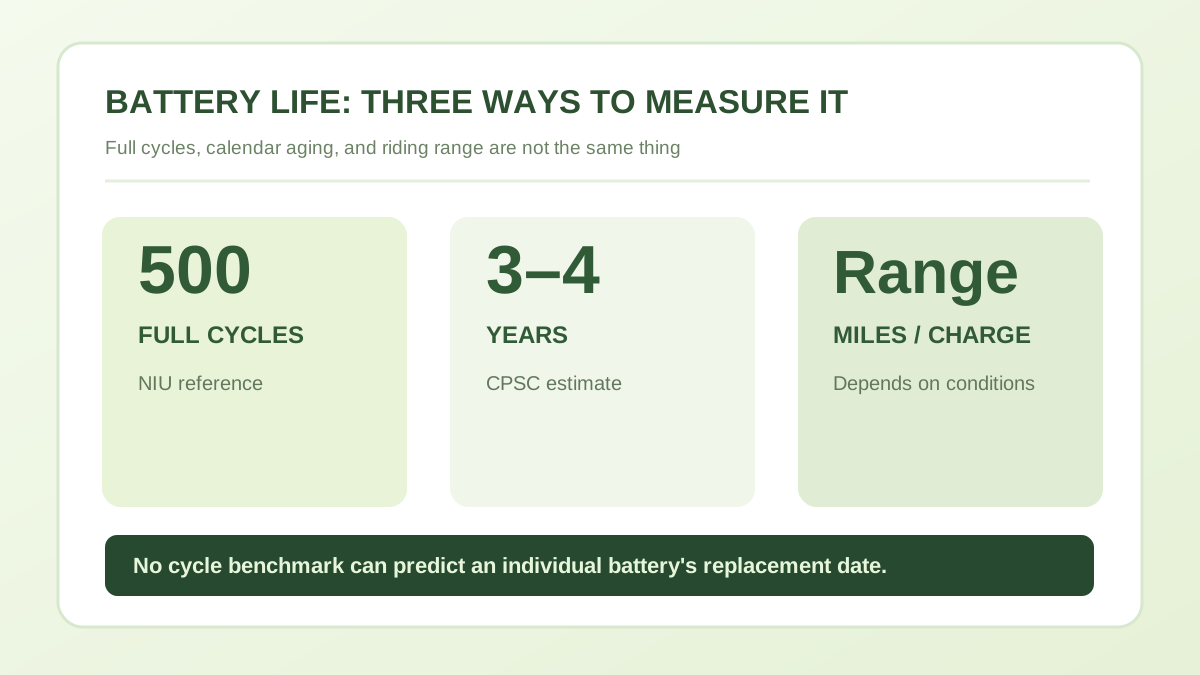
How long do electric scooter batteries last?
For stand-up electric scooters, a useful planning reference is roughly 500–800 equivalent full charge cycles and, in the CPSC staff's market analysis, around 3–4 years under optimal conditions. NIU separately says its kick-scooter packs are tested to reach 500 cycles before a noticeable everyday-use difference. The pack doesn't suddenly stop working at 500 cycles—it generally loses usable capacity over time. Actual results depend on the exact battery, storage, temperature and mileage. Understand cycles.
Battery Life Isn't Just One Number
The phrase “battery life” can mean how far you can ride today, how many charge cycles a pack tolerates, or how many calendar years it remains useful. Keeping these separate makes product specifications and personal battery comparisons more meaningful.
How far you can travel on one charge in your usual conditions. This changes with hills, rider weight, temperature and speed.
Equivalent full charge/discharge usage. Two half-depth discharges add up to roughly one full-cycle equivalent.
Time since the pack was manufactured or put into service. Aging occurs even when you aren't riding.
A 31-mile advertised range doesn't mean the battery lasts just 31 miles in its lifetime, nor does “500 cycles” mean 500 times plugged into a charger.
Check Your Range Change & Riding Usage
Record the distance you can actually ride under comparable conditions, enter your usual weekly mileage, then see how much of your original observed range remains. The tool does not claim to read your scooter's battery management system.
Battery Range & Cycle Calculator
Compare rides under similar conditions, then estimate how many equivalent full cycles your mileage represents. This cannot diagnose a battery or predict replacement.
Your measured distance is 5 miles shorter than the initial comparison ride.
Do not interpret the percentage as measured battery capacity. Terrain, cold weather, tire pressure, speed, load and testing conditions change the distance per charge.
How we calculate: comparison = current range ÷ original range; estimated equivalent full cycles per year = weekly miles × 52 ÷ original real-world range. This assumes similar riding conditions and energy use—not an onboard BMS reading. A cycle benchmark is not a guaranteed end-of-life date.
What Does a 500-Cycle Battery Mean?
A charge-cycle equivalent is the cumulative energy discharged roughly equal to one full battery's usable capacity. For intuition, two trips consuming approximately half a pack each may add up to one cycle. That's different from charging twice. Manufacturers sometimes define laboratory cycle tests differently, so compare their specifications carefully.
NIU's kick-scooter guidance says the batteries are tested for 500 cycles before a noticeable difference in daily use. A 2025 CPSC staff analysis (page 6) cites typical e-scooter pack life of 500–800 discharge cycles under its planning assumptions. These benchmarks are not directly comparable laboratory promises. See NIU's kick-scooter support explanation.
Same scooter, different usage
If your scooter normally travels 25 miles per full charge, riding 25 miles a week uses about 52 full-cycle equivalents per year. Riding 75 miles a week uses roughly 156. That doesn't predict an exact failure year: riding conditions, storage and calendar aging are independent factors.
How Long Does a Battery Last on One Charge?
The answer depends on the scooter's battery capacity and energy consumption. The NIU KQi3 Pro, for example, lists a 486 Wh battery, a manufacturer range of 31 miles and a six-hour charging time. These are published model specs, not our road tests, and 31 miles is not guaranteed in every riding situation. NIU KQi3 Pro official specifications.
Published battery capacity
Idealized model figure
Manufacturer specification
To compare battery wear, use repeatable rides: similar speed, route, load, temperature, wind and tire pressure. A scooter that reaches 20 miles in cold weather after reaching 25 miles during a warm, calm test has not necessarily lost 20% of its battery capacity. Try the comparison calculator.
How to Make Your Scooter Battery Last Longer
Avoid deep, prolonged discharge
Don't routinely run the scooter to empty or leave it fully depleted for weeks. Follow its low-battery and storage instructions.
Keep it out of excessive heat
Temperature matters both in use and storage. Avoid leaving a scooter baking in a vehicle or direct sunlight. Let the battery return to permitted charging temperatures.
Store it at the recommended charge
For long breaks, check your model's manual and app. Some makers recommend moderate charge and occasional monitoring; don't apply an arbitrary percentage to every battery.
Use the correct charger
Use the supplied charger or one specifically approved for that scooter. A plug that physically fits does not prove charger compatibility.
Charge while you're present
CPSC advises not to charge micromobility batteries while asleep or away from home and to unplug when charging is complete, following the maker's directions.
Don't charge a damaged or wet pack
If a battery was submerged, cracked, crushed, overheats, smells unusual or swells, stop using or charging it and seek qualified guidance.
For water exposure, consult our electric scooter waterproofing and rain guide. If you have charging or power problems, use our electric scooter not-charging troubleshooting guide before trying repairs.
Signs Your Scooter Battery May Need Attention
Shorter range is often a gradual aging symptom, but it can also reflect cold weather, underinflated tires, a brake dragging, more hills or riding faster. Look for repeatable changes and clear electrical warning signs.
Gradual shorter range
Repeat a similar route and load in similar weather. Check tires and the scooter's battery-health app before assuming permanent capacity loss.
Unexpected shutdowns or error codes
Stop riding and consult the manual and qualified service if power cuts out unexpectedly. Don't attempt battery-level electrical repairs yourself.
Swelling, smoke, odor or excessive heat
Stop charging and using the device. Move away from a distressed pack and contact emergency services if there is smoke or fire.
Some apps offer actual battery-health information. NIU describes a Battery Health Score in its app and explains its charging and temperature factors. A technician may be able to distinguish battery aging from a charger, tire, or controller problem.
Is a replacement battery worth the cost?
Use the original manufacturer's approved pack for your exact model and confirm installation costs. The decision depends on replacement availability, the scooter's age, other repair needs and the price of a comparable vehicle. Avoid unsupported “universal” replacement batteries. Find electric scooter repair businesses and check the repair cost estimator.
Battery Life FAQs
How many years do electric scooter batteries last?
CPSC staff cite about three to four years under optimal conditions as a typical market-planning figure, but real lifespan varies by battery, storage, temperature and use. A battery can remain useful after that period if it safely meets your range needs.
Does charging every day use up one cycle?
No. One equivalent full cycle means cumulative use of roughly 100% of pack capacity. Two 50% discharges may count as roughly one equivalent full cycle, although manufacturer test methods differ.
Does a battery die at 500 cycles?
No. NIU's 500-cycle reference indicates a wear benchmark for kick-scooter batteries, not a switch that turns the battery off or a universal replacement requirement.
Does a drop in miles per charge prove battery damage?
No. Range depends on the route, hills, temperature, wind, tires, speed and load. Compare similar rides and look for error messages or other symptoms.
Should I always charge only to 80%?
Use the specific scooter manufacturer's charging guidance. A partial-charge strategy may help reduce stress for some lithium-ion packs, but a fixed limit is not appropriate for every battery management system or riding need.
How do I check battery health on a NIU scooter?
NIU describes a Battery Health Score in its app, under Vehicle and Battery Info for supported models. Check your app version and scooter model.
Can I use a universal charger to extend or replace battery life?
No. CPSC warns that chargers advertised as universal may not be electrically compatible even when the connector fits. Use the supplied or maker-approved charger only.
Is a scooter's battery range the same as its battery lifespan?
No. Range measures miles per charge; lifespan describes how long the battery remains useful across cycles and years.