
Where Did Mopeds Originate? The Story Behind Motor + Pedal
The name was coined in 1950s Europe, but the idea is older. Here's how motor-assisted bicycles became the mopeds that helped generations get around—and why a moped and a Vespa-style scooter aren't quite the same thing.
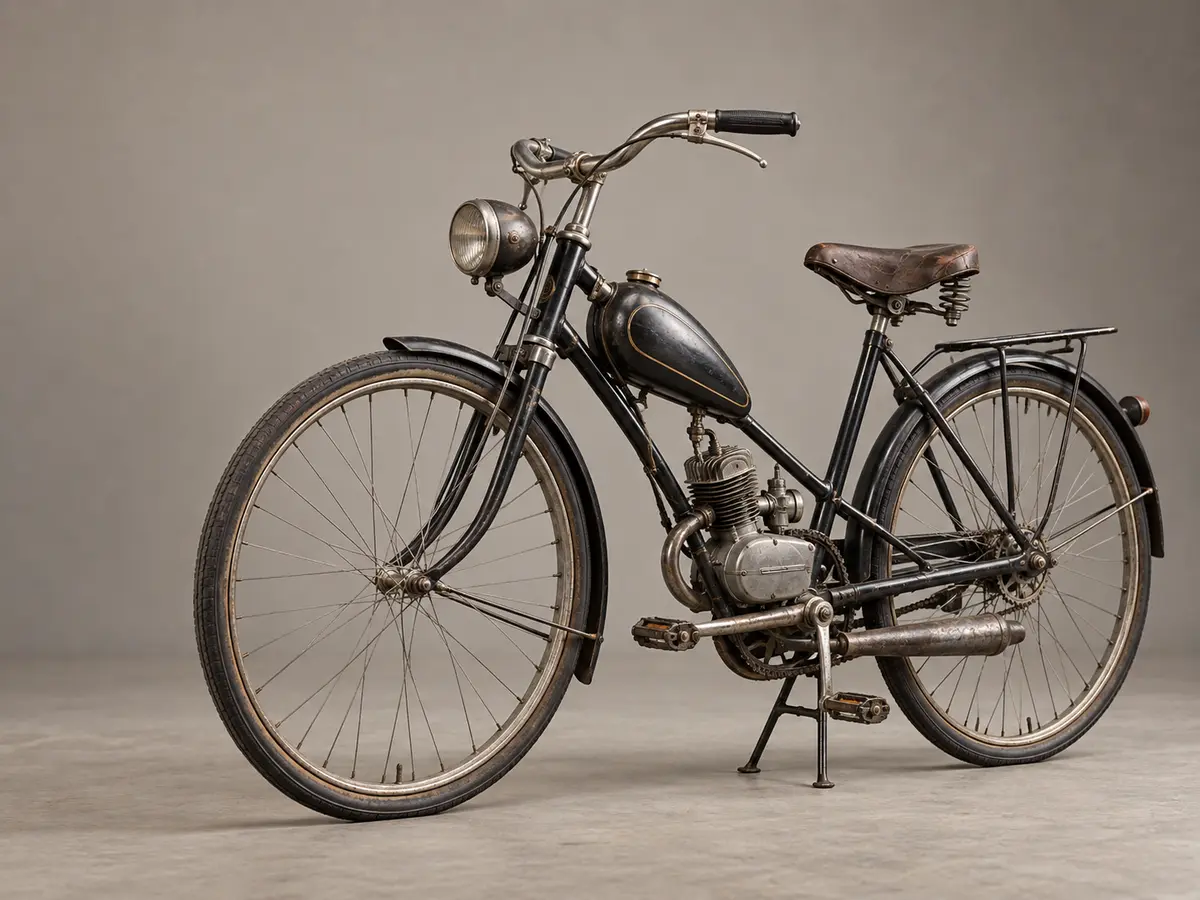
The moped timeline: from powered bicycle to everyday transport
Rather than naming one inventor, it is more accurate to follow two parallel stories: the vehicle evolved gradually, while the word appeared later. These dates mark documented milestones, not a claim that every new model was the world's first.
Motorized bicycle experiments
Engineers had been trying to add power to pedal bicycles before mopeds had a name. Husqvarna's own history records a Swedish bicycle fitted with an engine in 1903. It was part of the broader motorcycle and motor-bicycle experiment—not a model marketed as a “moped.”
VéloSoleX enters the market
French maker Solex began selling its light motor-assisted bicycle in 1946. Its famous arrangement used a small engine to drive the front tire with a roller. It kept bicycle-like simplicity while adding useful assistance for everyday errands and commuting.
The name “moped” emerges
The Swedish motor + pedaler blend gave the practical class of pedal-equipped powered cycles a memorable name. The English record of the word is later, which helps explain why earlier machines were called cyclemotors or motorized bicycles instead.
NSU Quickly popularizes the new class
NSU showed its 49cc Quickly at the Frankfurt bicycle and motorcycle show in October 1953. Manufacturer heritage materials describe a small two-speed machine with functional pedals that was designed for newly created lightweight-vehicle rules.
Piaggio introduces the Ciao
Piaggio's Ciao turned the moped into an easy-to-recognize lightweight everyday machine. The company places its debut in 1967; its family later expanded with models such as the Bravo and Sì.
Pedals become less central
Lightweight powered two-wheelers spread to new markets and adopted different frames and transmissions. In many modern legal categories, pedals are no longer required. What a jurisdiction calls a moped can now depend more on speed, motor power and registration rules.
Who invented the word “moped”?
The most useful answer is Sweden, around 1952. The Online Etymology Dictionary traces the English word through German to Swedish motor och pedaler—motor and pedals—and dates the Swedish usage to roughly 1952. English-language use is recorded in the mid-1950s.
Swedish motoring history often credits journalist Harald Nielsen with coining the short name. There is a wrinkle worth knowing: Audi Tradition's NSU history describes a German naming competition associated with the new 1953 class. Those are different historical accounts, and neither means one inventor created the entire vehicle in 1952.
Important distinction: The word's early-1950s origin is not the same as the first invention of a powered two-wheeler. Pedal-and-engine bicycles already existed.
Four historic machines that explain how mopeds evolved
Early motor bicycles: the missing link
A small engine attached to an ordinary-looking bicycle solved a practical problem: riders could still pedal but had help on longer or harder journeys. Husqvarna documented a motorized Swedish bicycle in 1903. This concept came long before the term moped became common.
VéloSoleX: the postwar French answer
VéloSoleX shows why mopeds appealed to commuters: it was deliberately modest. Instead of taking on the weight and complexity of a motorcycle, the French machine used a compact front-wheel roller-drive engine. Solex's own brand history dates its first sales to 1946 and describes rapid postwar growth.
NSU Quickly: a German moped with a purpose-built frame
The Quickly represents a shift from an add-on motor to a complete lightweight vehicle designed for a specific road class. According to Audi's company-history material, the October 1953 debut featured a 50cc-class engine, manual gears and bicycle-style pedals. It became a familiar symbol of affordable mobility in postwar Germany.
Piaggio Ciao: the moped becomes a design icon
By the late 1960s, mopeds had a recognizable personality of their own. Piaggio's official timeline dates the Ciao to 1967. It was followed by other small machines that made this class of transport especially visible in Italian everyday life.
Moped vs scooter vs motorized bicycle: what's the difference?
People casually use these terms as if they mean the same thing. Historically they describe different design ideas, and today's laws may draw the lines differently.
Traditional moped
Small motor and bicycle pedals. The rider could sometimes pedal to start the engine, assist a hill or continue when the motor was off.
Motorized bicycle
A bicycle with an auxiliary motor; early examples could look almost exactly like ordinary bicycles. Some were later described as mopeds.
Motor scooter
Typically designed around a seat, leg shield or step-through floorboard, and footrests rather than bicycle pedals. The 1946 Vespa belongs to this scooter story, not the origin of pedal-assisted mopeds.
Modern legal “moped”
Often a regulatory class defined by speed, engine output and licensing rules. It may include pedal-free machines, depending on the jurisdiction.
The names describe different things: motor scooter can describe vehicle shape, while moped may be a legal or performance category. That's why a dealer might call a 50cc step-through a moped even though it has no pedals. For a practical comparison of present-day machines, see how much modern mopeds and scooters weigh, with manufacturer specifications.
Why modern mopeds don't always have pedals
As engines and drivetrains became easier to start and operate, pedals became less necessary. Lawmakers also changed how they classified small motorcycles. In the United States, NHTSA explains that its federal motor-vehicle rules don't use the marketing labels moped or motor scooter to decide which motorcycle safety standards apply.
State road rules are a separate question. For example, California's DMV says some mopeds have pedals, but a moped is a regulated vehicle class with specific licensing and plate requirements. Your state may define it differently.
If you're shopping for a new 50cc scooter, examine the exact model and your state's current requirements. Don't assume that “moped” means it can be used without a motorcycle license, registration or helmet.
Frequently asked questions
Which country invented the moped?
No single country can be credited with inventing the entire machine. Engine-assisted bicycles were developed in several places before 1952. The word “moped” is generally traced to Sweden; iconic postwar moped models emerged from France, Germany and Italy.
When was the first moped invented?
It depends on your definition. Bicycle-and-engine combinations existed before 1903, while the name “moped” dates to around 1952. The VéloSoleX (1946) and NSU Quickly (1953) are documented milestones, not a universally accepted first model.
Why is a moped called a moped?
It combines parts of the words for motor and pedals. Early mopeds often retained working bicycle pedals.
Was the Vespa the first moped?
No. Piaggio launched the original Vespa motor scooter in 1946, but that is a different branch of small two-wheel transport. The motorized-bicycle tradition—and eventually the word “moped”—developed along its own path.
Are mopeds and scooters the same in the United States?
Not necessarily. Terms vary between manufacturers, everyday speech and state law. Check the state DMV definition of the actual vehicle before deciding what license, registration and equipment it needs.
More reading: Compare modern scooter brands · Find scooter dealers · Browse the directory.
Sources and editorial method
This guide distinguishes first uses of a name from earlier vehicle inventions, favors makers' records and official vehicle classifications for specific factual claims, and flags different accounts of the word's coinage. It is documentary research, not firsthand testing of vintage machines.
- Husqvarna: The first motorised bike (1903).
- Solex: Official brand history (first sales 1946).
- Online Etymology Dictionary: Origin of “moped”.
- Audi Tradition: NSU Quickly history (1953).
- Piaggio Group: Corporate history (Vespa 1946, Ciao 1967).
- U.S. NHTSA: Motorcycle and scooter classification.
- California DMV: Mopeds and scooters (state example, not nationwide law).