
ELECTRIC SCOOTER BUYING GUIDE · UPDATED OCTOBER 2026
Razor E300 Electric Scooter Review: Is It Still Worth Buying?
The classic E300 has a wide deck, comfortable air-filled tires and enough speed to be fun. But its heavy frame, long charging time and old-school battery make it a very different purchase from today’s folding commuter scooters.
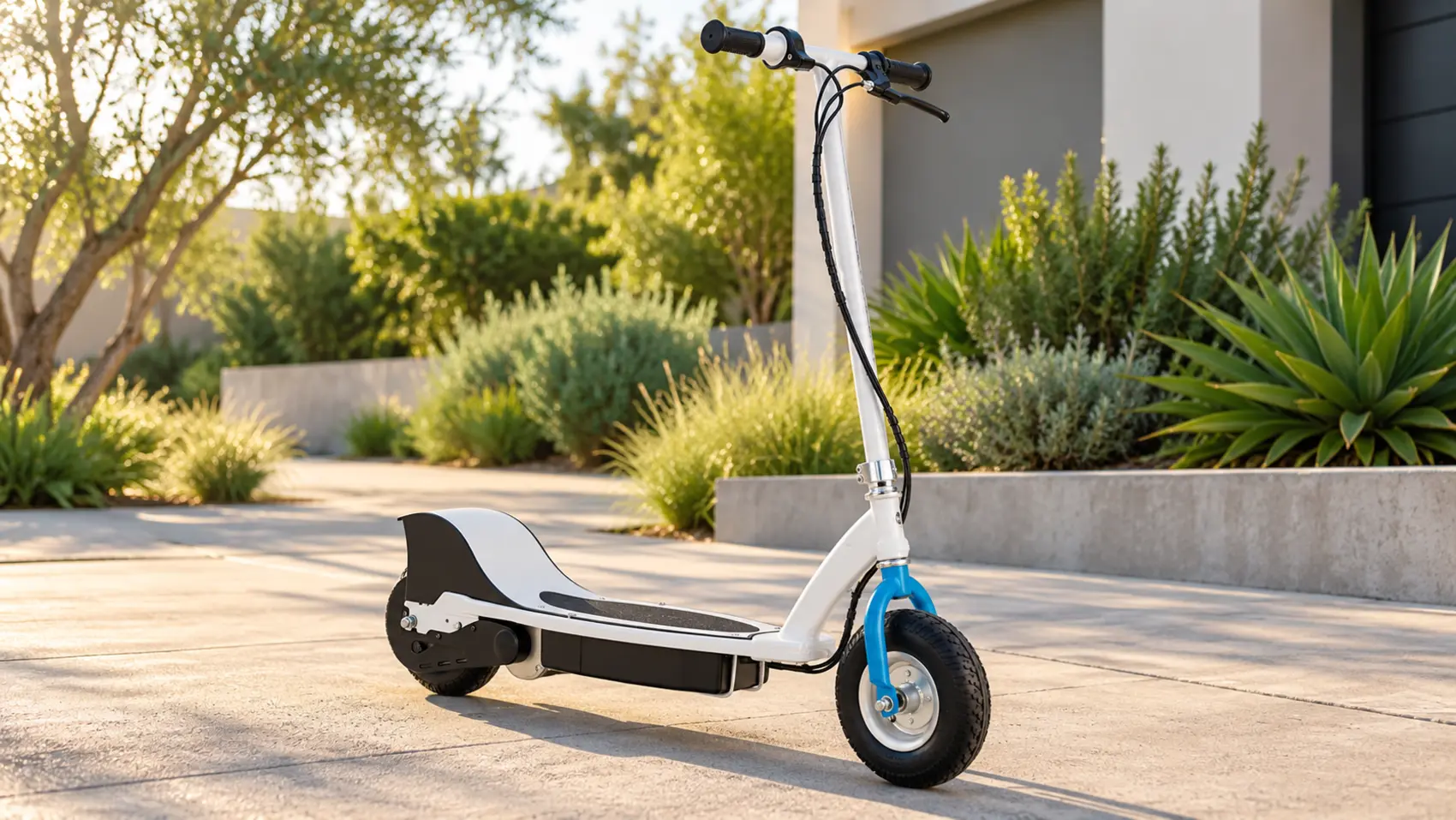
A fun neighborhood scooter, not a daily commuter
The Razor E300 makes sense for an older teen who wants simple, short rides on flat, dry pavement and has somewhere to store it. It’s less appealing if you need to carry a scooter upstairs, fold it into a trunk, ride after dark, or depend on it for a daily commute.
This article contains an Amazon affiliate link. As an Amazon Associate, TheScooterist earns from qualifying purchases.
Razor E300 — classic standing version
View the white-and-blue E300 and current seller options on Amazon. Confirm the model designation and availability before buying.
Razor E300 specs at a glance
These figures describe the classic standing E300 with a chain-driven motor, not the seated E300S or the different E300 HD. Razor notes that details can vary by production version.
| Recommended rider age | 13 years and older |
|---|---|
| Top speed | Up to 15 mph (24 km/h) |
| Claimed ride time | Up to 40 minutes of continuous use |
| Motor | 250W, single-speed, chain-driven |
| Battery | 24V sealed lead-acid system (two 12V batteries) |
| Tires | 9-inch pneumatic front and rear |
| Throttle and brake | Twist-grip throttle, hand-operated rear brake |
| Charge time | Up to 12 hours; 12-hour initial charge |
| Rider weight limit | 220 lb (100 kg) |
| Scooter weight | Approximately 52 lb (23.7 kg) |
| Folding design | No |
Speed and run time are manufacturer maximums, not guaranteed results for every rider or route.
Who should buy the Razor E300?
It’s a good fit if…
- The rider is 13 or older and comfortable controlling a scooter that can reach 15 mph.
- Most rides will be short trips for fun on flat, dry, private or otherwise permitted pavement.
- You value a roomy deck and pneumatic tires over portability and extra electronics.
- You can store the scooter indoors and charge it between rides.
Look elsewhere if…
- You need to fold or routinely lift the scooter onto public transport or up stairs.
- You expect a long commute, a quick recharge, or an exact distance from each charge.
- You need an integrated headlight, display or other commuter conveniences.
- Your regular route includes steep hills, water, loose gravel or heavy traffic.
Buying for a younger child? The E300 is not a substitute for an age-appropriate model. Our guide to children’s scooter styles explains the importance of fit, steering and age suitability.
Ride comfort, speed and handling
The E300’s main strength is straightforward: its wide standing platform and 9-inch pneumatic tires make recreational riding less cramped than on small toy-style scooters. Those air-filled tires can soften ordinary pavement seams and minor surface imperfections. They do not turn the E300 into an off-road scooter or replace careful riding.
A twist of the handgrip controls the motor, and a lever operates the rear brake. With a stated top speed of up to 15 mph, learning how the scooter accelerates and stops matters more than chasing its maximum speed. Rider weight, tire pressure, hills and battery charge all affect real-world performance.
There are meaningful compromises. The E300 has no folding mechanism, its approximately 52-pound weight makes frequent lifting awkward, and the classic chain drive requires periodic attention. It is better thought of as a sturdy recreational machine with a parking spot than as something you toss into a backpack or carry onto a bus.
Battery life: what “up to 40 minutes” really means
One of the easiest mistakes is treating 40 minutes of operation as a guaranteed trip distance. It isn’t. Razor describes up to 40 minutes of continuous riding under suitable conditions. Starting and stopping, inclines, lower tire pressure, a heavier rider, temperature and battery age can shorten that time.
What Razor states
Up to 40 minutes of continuous use in favorable conditions.
What you can count on
No fixed mileage. Plan a short loop close to home until you learn your scooter’s actual endurance.
Instead of calculating an optimistic mileage by multiplying top speed by ride time, build in a return-home margin. A recreational scooter running near its maximum speed for a full charge is not a safe assumption for planning a long trip.
Charging takes patience
The classic E300 uses two 12V sealed lead-acid batteries, not the lighter lithium-ion pack found on many contemporary commuters. Razor’s owner’s manual specifies an initial charge of 12 hours and a recharge of up to 12 hours, even if the charging indicator changes color early. The manual also recommends a maximum charging time of 24 hours.
Use the recommended charger, switch the scooter off when it is parked, and keep the battery maintained during storage. Repeated deep discharge or leaving the scooter unused without periodic charging can shorten battery service life. For a unit that suddenly stops charging, start with our electric scooter troubleshooting guide rather than guessing which component failed.
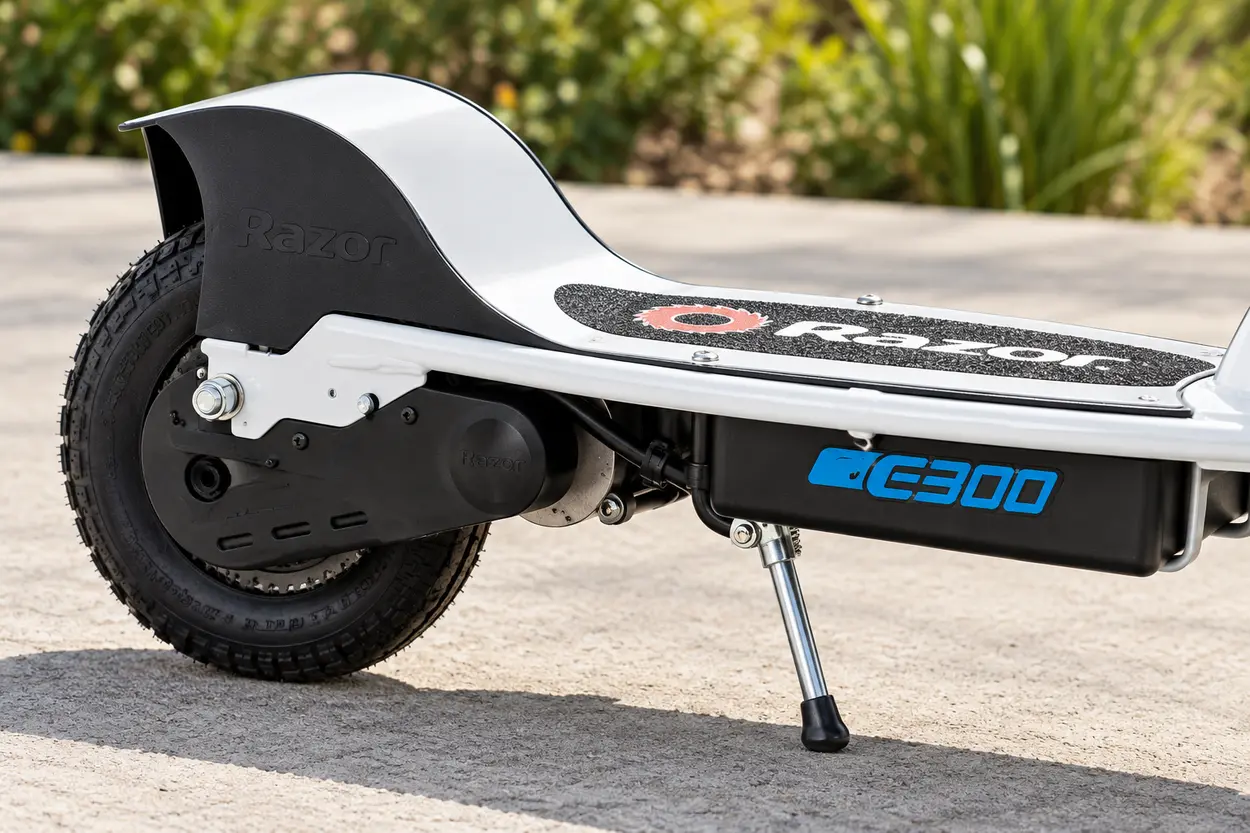
What ownership actually involves
The E300 is mechanically simple, but it is not maintenance-free. Its pneumatic tires can lose air or puncture, the brake needs to work reliably, and the chain must be protected and kept in proper condition. Razor provides replacement guides for the E200 and E300 family, including tires, motors, chains and battery components.
Before the first ride
Have an adult assemble and inspect the handlebars, fully charge the battery, and set tire pressure to the value printed on each tire sidewall.
Before every ride
Check the rear brake, tires, throttle, guards and visible damage. Wear an approved helmet and appropriate protective gear.
After every ride
Switch off the power, keep the scooter dry, and follow Razor’s charging instructions. Let hot motor and brake components cool before handling them.
When performance drops
Check charge state and tire condition before assuming the motor is bad. Use the correct version-specific manual and replacement parts.
For help beyond basic checks, you can browse electric scooter repair businesses or parts and accessories businesses in TheScooterist directory.
Razor E300 vs. E300S vs. E300 HD: don’t mix them up
These names are easy to confuse in search results. Check the exact model name and photographs on an Amazon listing before ordering, particularly if you’re comparing parts.
| Model | Key difference | What to check |
|---|---|---|
| E300 (classic) | Standing scooter with chain-driven motor | This review and the link below refer to this version. |
| E300S | Seated model in the classic E300 family | Seat and mounting hardware; confirm model-specific compatibility. |
| E300 HD | Different hub-motor design | Do not assume drivetrain or repair parts match the chain-driven E300. |
Model distinctions are confirmed in Razor’s separate E300/E300S and E300 HD manuals.
So, should you buy the Razor E300?
Yes—if you want a classic neighborhood scooter for an older teen and understand its limits. It can be a satisfying way to enjoy short rides on smooth pavement. The large tires, roomy deck and simple controls make sense for that purpose.
Probably not—if your priority is transportation. A long recharge, non-folding steel frame, lead-acid battery and basic equipment are difficult tradeoffs for everyday commuting. For that use, compare the features and practical differences in our folding electric scooter guide.
Frequently asked questions
How fast is the Razor E300?
Razor gives the classic E300 a top speed of approximately 15 mph (24 km/h). Speed varies with the rider, terrain, tire pressure and state of charge.
How many miles can the Razor E300 go?
Razor specifies ride time—up to 40 minutes—rather than a guaranteed mileage. Avoid translating that into a fixed range. For planning, test short rides and always keep a return-home margin.
How long does a Razor E300 take to charge?
Razor’s E300 owner’s manual specifies a 12-hour initial charge and up to 12 hours for subsequent recharges. Follow the instructions for the particular scooter and charger you own.
Can an adult ride the Razor E300?
Yes, an adult can ride it provided they fit comfortably, can operate it safely and weigh no more than the stated 220-pound limit. The scooter itself weighs about 52 pounds, so portability is a separate consideration.
Can you ride a Razor E300 in the rain?
No. Razor advises riding on flat, dry surfaces and avoiding water, wet weather and slippery conditions. The E300 is not intended as an all-weather commuter scooter.
Does the Razor E300 fold?
No. The classic E300 has a fixed frame, which is important if you need to store it in a small space or carry it upstairs.
Good fun when expectations match the machine
The E300 is appealing precisely because it is simple: a broad deck, comfortable tires, a motor and a throttle. Give it dry pavement, time to recharge and a sensible riding area. Just don’t expect the portability or convenience of a modern commuter scooter.
For safety, setup and maintenance instructions, see the official Razor E300/E300S owner’s manual. The illustrations on this page are original editorial visuals, not manufacturer product photographs.