
Born from the same ingenuity as the Vespa, the Piaggio Ape became a delivery truck, a neighborhood fixture, a holiday icon, and eventually an international family of working vehicles.
In the Italy of the late 1940s, a delivery did not necessarily arrive in a van. On narrow streets, shopkeepers moved produce, bread, tools, and parcels with handcarts, pedal tricycles, or whatever transport they could afford. Large trucks were expensive and often impractical. What small businesses needed was something between a scooter and a commercial vehicle.
Piaggio had an answer: the Ape, pronounced AH-peh, Italian for “bee.” Small, economical, and able to carry a useful load through tight streets, it brought a new kind of mobility to a country rebuilding after World War II. Its story stretches far beyond the original cargo bed—and well beyond Italy.
1948: A working cousin of the Vespa
The Vespa arrived in 1946, designed by aeronautical engineer Corradino D’Ascanio at the request of Enrico Piaggio. The scooter made personal transportation simpler and more accessible. But Piaggio could see another need taking shape: affordable transportation for Italy’s shopkeepers, farmers, artisans, and tradespeople.
The idea behind the Ape was wonderfully direct. Keep the compact, easy-to-handle spirit of a Vespa, add a third wheel and a cargo area, and create a vehicle small enough for old city streets but useful enough to earn its keep. Early development began before its broad commercial introduction; Piaggio dates the Ape’s market debut to 1948.
The first production Ape shared the Vespa’s recognizable front-end character and used a 125cc engine. Its original list price was 170,000 Italian lire, according to Piaggio’s historical account. It was not trying to compete with a full-size truck. Its advantage was being a practical tool for businesses that might otherwise depend on manpower or a bicycle.
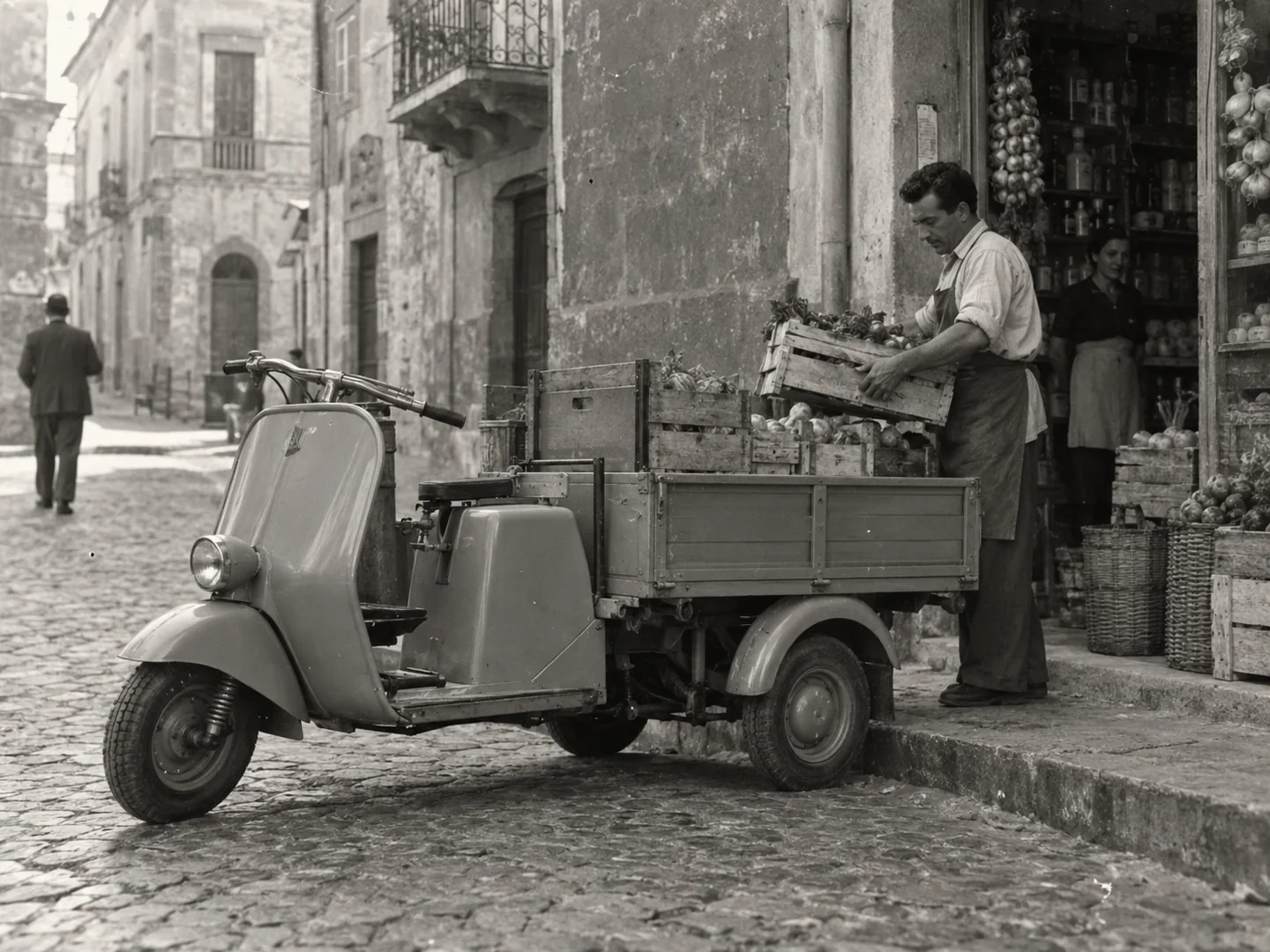
The vehicle’s nickname fit its character. A vespa is a wasp; an ape is a bee. The scooter gave people freedom to move. The three-wheeler went to work, buzzing between storefronts and customers with a company name often painted across its cargo box.
The 1950s: Built for Italy’s small-business boom
As Italy’s economy recovered, businesses needed to deliver more goods and make more journeys. Piaggio steadily developed the Ape to match that demand. In 1952, the engine grew from 125cc to 150cc. The cargo platform evolved too, with the Ape C becoming capable of carrying around 350 kilograms in Piaggio’s historical specifications.
These upgrades sound modest in isolation, yet they mattered enormously to a neighborhood shop. A larger payload could mean fewer deliveries. Better weather protection could make the workday easier. A vehicle that fit down a narrow lane could serve customers unreachable by larger trucks.
By 1958, the Ape D brought a more substantial body, an enclosed cab with doors, and a 170cc engine. The Ape was no longer just a scooter with a box behind it. It was becoming a distinctive category of light commercial transport, one that could be adapted to the rhythm of everyday urban life.
The 1960s: An experiment with five wheels—and a smarter drivetrain
Piaggio did not stop experimenting with the basic three-wheel idea. In 1961, it introduced the unusual Pentarò, a miniature articulated load carrier with five wheels. Its reported carrying capacity of approximately 700 kilograms showed how far the concept could be stretched.
The more consequential changes came in the middle of the decade. The Ape MP, introduced in 1966, improved the cab and moved toward a more sophisticated mechanical layout. The engine was positioned at the rear, and the earlier chain-drive arrangement gave way to drive through axle shafts. More capable suspension components helped turn the Ape into a better-rounded work vehicle.
Then, in 1968, Piaggio offered a steering wheel as an alternative to scooter-style handlebars on the Ape MPV. The little truck was gradually borrowing ideas from the automobile without losing the maneuverability that made it special.
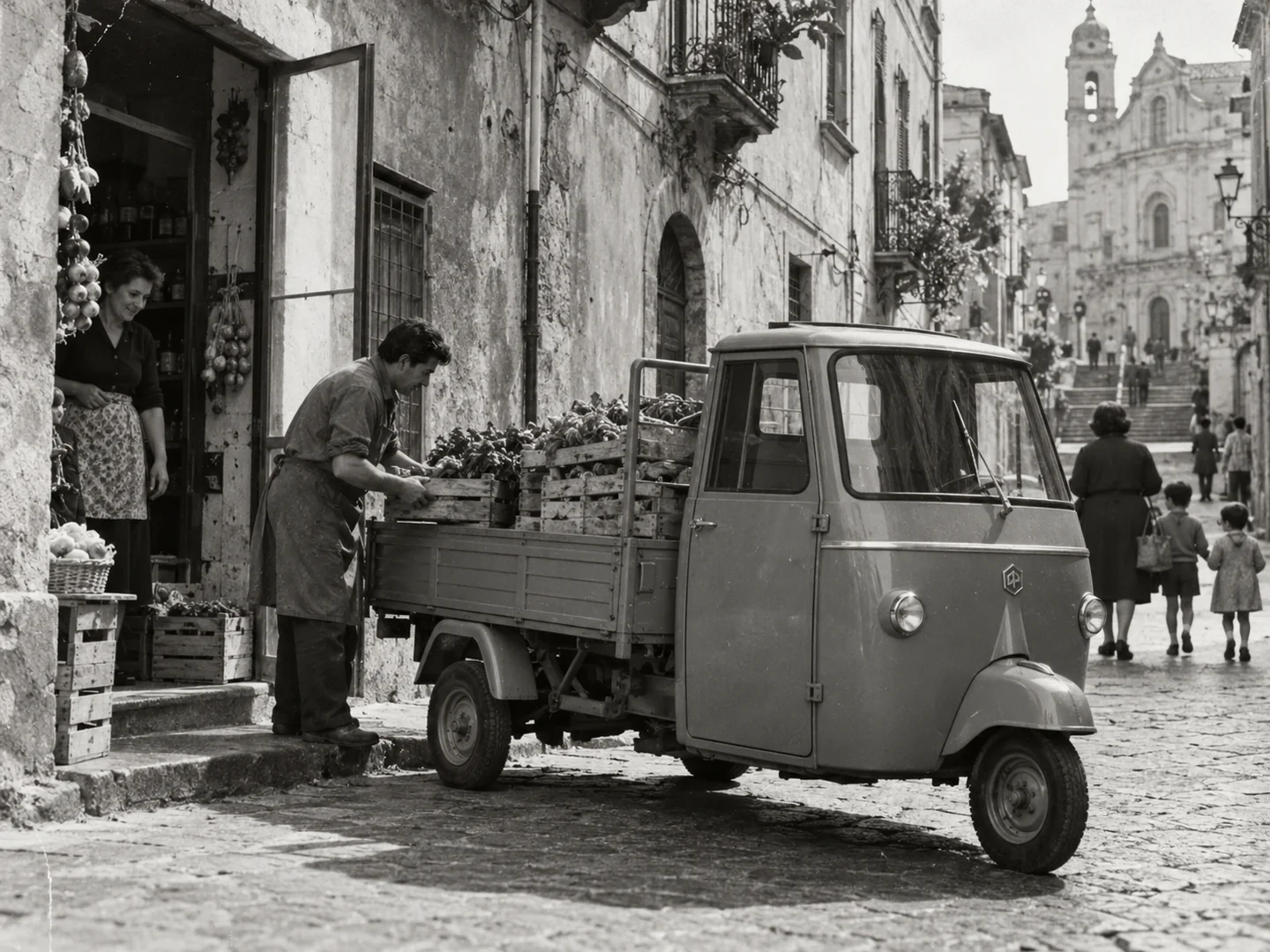
1969–1971: The Ape 50 and the Ape Car take different roads
In 1969, Piaggio launched the Ape 50, affectionately known as the Apino or “little Ape.” Its small engine placed it in a different class from larger commercial vehicles and gave the model a personality of its own. Over time, the Ape 50 also became associated with youthful customization in parts of Italy.
Two years later, the 1971 Ape Car pursued the other end of the market. Its larger, roomier cab and 220cc two-stroke engine moved the platform closer to a conventional light truck. It was still unmistakably an Ape, but it offered a different answer to the same question: how much useful transportation can you fit into a compact vehicle?
This ability to branch into specialized versions became one of the Ape’s lasting strengths. Where one owner needed a nimble small runabout, another required a vehicle built to carry heavier loads all day.
The 1980s and 1990s: Design, diesel, and a new generation
The Ape received a striking makeover in 1982 with the Ape TM, styled by the celebrated Italian designer Giorgetto Giugiaro. A more automotive-looking cabin and dashboard made the vehicle feel less like a modified scooter and more like a purpose-built work machine.
In 1984, a 422cc diesel version broadened the range. Then came the Ape Max in 1986, with a payload figure of up to 900 kilograms in Piaggio’s period account. These were serious specifications for a family that had begun with a tiny cargo box on a Vespa-like chassis.
The Ape also developed a playful side. The Ape Cross, introduced in 1994 and based on the Ape 50, offered sportier styling and features aimed at younger drivers. It was a reminder that even a hardworking utility vehicle could become a cultural object—one people wanted to personalize, not merely operate.
From delivery vehicle to la dolce vita: The Ape Calessino
The most charming twist in the story is the Ape Calessino. Long before its modern revival, open-sided passenger versions of the Ape had become part of the scenery in Mediterranean resorts. A compact three-wheeler looked perfectly at home carrying guests through towns where the streets were steep, winding, and too narrow for larger cars.
Piaggio revived the Calessino in 2007, drawing deliberately on this mid-century image. The first revived edition was limited to 999 examples. Its canvas canopy, retro details, and relaxed passenger layout emphasized atmosphere as much as transportation. In 2013, Piaggio introduced a further Calessino version based on its passenger-vehicle platform used in India.
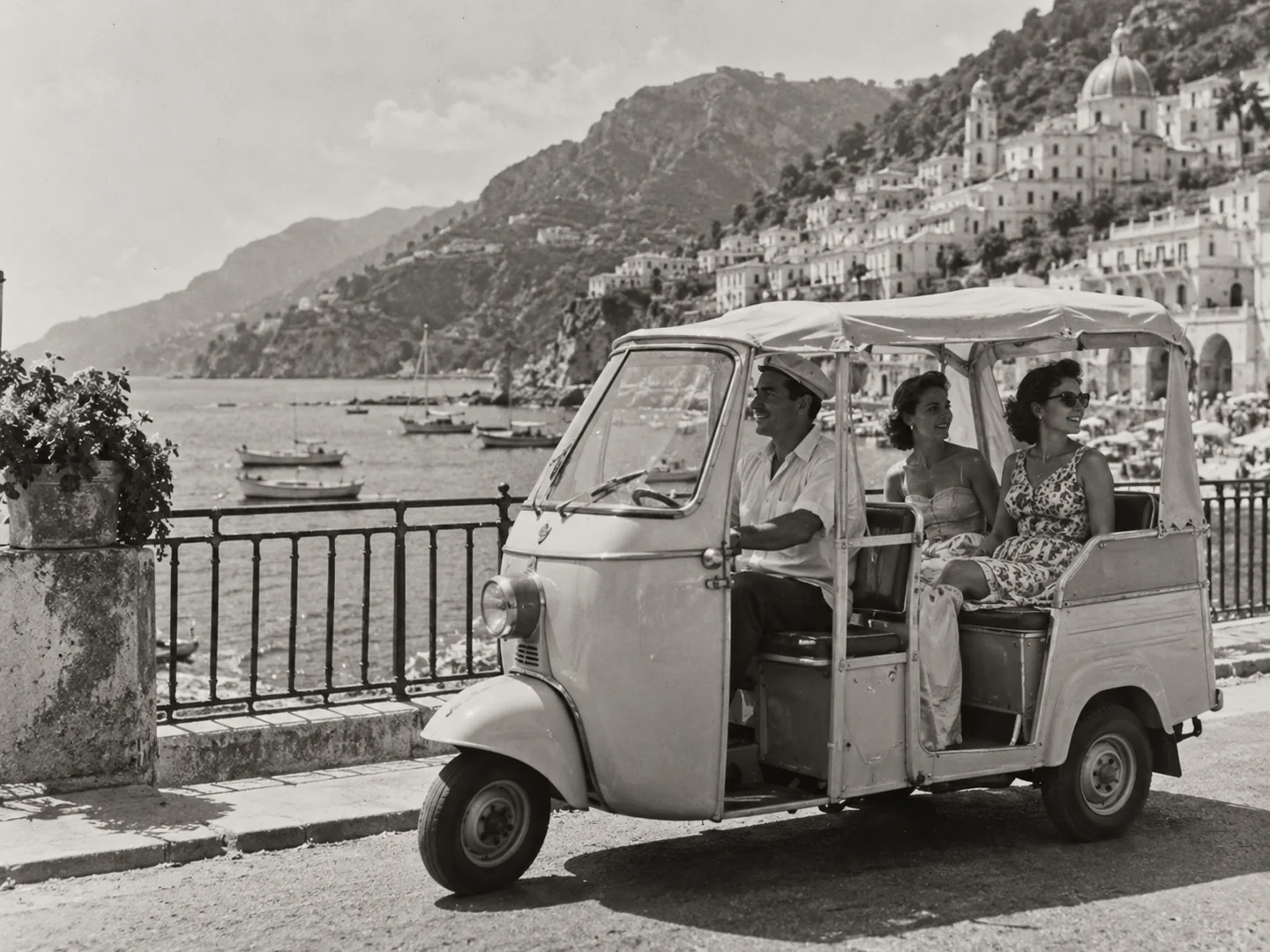
The Calessino shows why the Ape is more than a machine. The very shape once associated with fruit deliveries and building supplies could also suggest summer holidays, waterfront promenades, and Italian design. Few commercial vehicles make that transition so naturally.
Beyond Italy: The Ape goes global—and electric
Although its silhouette will always be tied to Italy, the Ape’s usefulness traveled. Piaggio established significant three-wheeler production and sales in India, where compact cargo and passenger vehicles fill important roles in local commerce and transportation. Passenger variants belong to the broader world of vehicles often called auto-rickshaws or tuk-tuks.
The idea has continued to evolve. In December 2019, Piaggio introduced the Ape E-City, an electric three-wheeler for the Indian market with battery-swapping technology. In 2022, the company announced additional electric passenger and cargo models in the Ape FX Max range. They look very different from the first Vespa-derived cargo carriers, but they respond to much the same practical questions: cost, space, flexibility, and short-distance travel.
The Ape’s story should not be confused with the availability of any particular historic model in any country today. Engines, road rules, and market lineups have changed dramatically since 1948. What has endured is the concept.
Why the Piaggio Ape became an Italian icon
The Ape succeeded because its design followed a real need rather than a fashion. It was small where roads were small, simple where budgets were limited, and adaptable where a business had a job to do. As Italy changed, the Ape changed with it: larger cargo beds, enclosed cabs, different controls and engines, passenger bodies, and eventually electric drivetrains.
Its visual appeal matters too. The compact front wheel, friendly proportions, and unmistakable three-wheeled stance made it recognizable at a glance. An Ape parked outside a café can feel like part of the architecture. One carrying tomatoes to a market still looks like it belongs to the same family as the little truck that first went on sale in 1948.
The Ape was never simply a smaller truck. It was an affordable way for people to get more done—and, along the way, it became one of the most memorable vehicles to emerge from postwar Italy.
Quick questions about the Piaggio Ape
What does “Ape” mean in Italian?
Ape means bee. The name complements Vespa, which means wasp, and reflects the little working vehicle’s busy character.
When was the Piaggio Ape introduced?
Early development took place in the postwar years, and Piaggio identifies 1948 as the year the Ape entered the market.
Is the Piaggio Ape the same as a Vespa?
No. The original Ape drew heavily on Vespa engineering and styling, but it was designed as a three-wheeled light goods vehicle, not a conventional two-wheel scooter.
What is an Ape Calessino?
It is a passenger-oriented, often open-sided version of the Ape associated with Mediterranean holiday destinations. Piaggio revived the Calessino in 2007 as a retro-inspired limited edition.
Sources and further reading
- Piaggio Group — Ape (1948–2019): An Italian Story — the manufacturer's historical model chronology.
- Piaggio Group — Company History — context on Enrico Piaggio, Corradino D’Ascanio, and postwar production.
- Piaggio Group — Ape Calessino 2009 — information about the 2007 Calessino revival.
- Piaggio Group — Ape E-City (2019) — official electric-model announcement.
- Piaggio WIDE Magazine — Ape FX Max Range — coverage of the 2022 passenger and cargo electric range.
Editor's image note: All three visuals on this page are modern, AI-generated historical recreations. They illustrate the setting and spirit of the Ape’s past, but they are not original period photographs and should not be used as documentary evidence for particular model details.