
01
Best everyday option
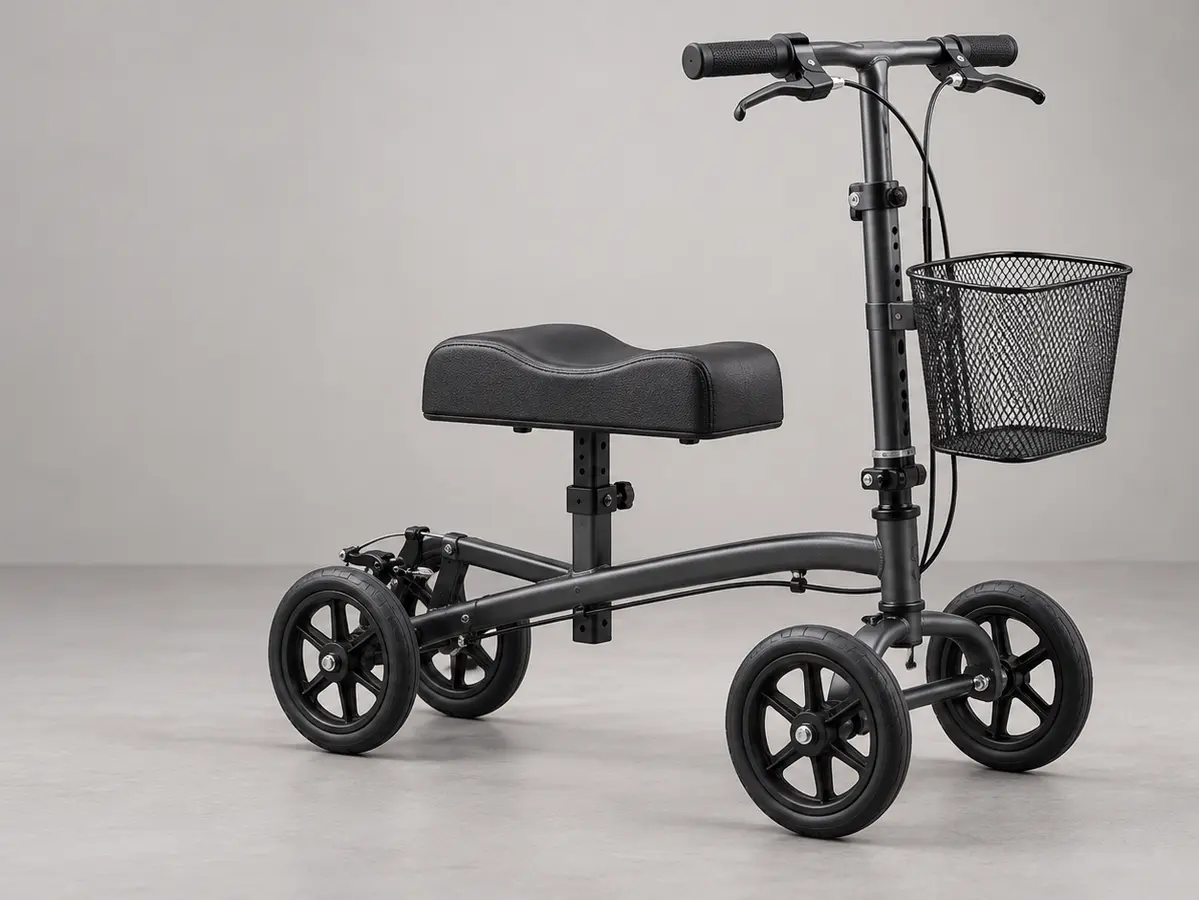
KneeRover Steerable Knee Scooter
- Wheels
- 4 × 7.5 in solid
- Max weight
- 300 lb
- Pad height
- 17.5–22 in
- Device weight
- 21.9 lb
- Surface
- Mostly smooth
Choosing a knee scooter starts with your knee-pad height and the places you need to move—not a generic star rating. Here's a practical, source-checked shortlist for different recovery routines.
We selected six models with identifiable manufacturer pages and distinct real-world tradeoffs. Product weights, knee-pad ranges and capacities are maker-reported, not measurements from our own testing. The knee-pad height range is especially important: matching only the model's suggested overall user height can still leave the pad too high or too low.
| Model | Wheels | Capacity | Knee-pad range | Device weight | Best surfaces | Read |
|---|---|---|---|---|---|---|
| KneeRover Steerable Knee ScooterBest everyday option | 4 × 7.5 in solid | 300 lb | 17.5–22 in | 21.9 lb | Mostly smooth | Details ↓ |
| KneeRover GOBest for tight storage | 4 × 7.5 in solid | 300 lb | 15–21.5 in | 21.1 lb | Mostly smooth | Details ↓ |
| Drive Medical Steerable Knee Walker 796Best high-capacity standard walker | 4 × 7.5 in casters | 350 lb | 16.75–20.5 in | 21 lb | Mostly smooth | Details ↓ |
| Vive Health Knee WalkerBest storage-bag alternative | 4 × 8 in wheels | 300 lb | Confirm before ordering | Not verified | Mostly smooth | Details ↓ |
| KneeRover GO HybridBest compact mixed-surface choice | 2 × 9 in air front; 2 × 7.5 in solid rear | 300 lb | 16.5–23 in | 22.5 lb | Maintained mixed surfaces | Details ↓ |
| KneeRover All TerrainBest for rougher maintained paths | 3 × 12 in air + stabilizer | 350 lb | 18–22 in | 26.3 lb | Maintained uneven paths | Details ↓ |
Specifications checked October 27, 2026. Manufacturer versions and stock can change. “Mostly smooth” is an editorial use-case label, not a tested terrain rating.
Enter your floor-to-bent-knee measurement, then select where you will use the walker and whether you will often fold it for travel. We check the published height ranges and highlight appropriate starting points—not a medical prescription.
How to measure: bend your injured-side knee approximately 90° while supported, and measure from floor to the bottom of the knee with assistance if needed.
These are editorial “best for” picks, not claims that we personally tested or medically endorsed the equipment. Start with dimensions and fit. Read the tradeoffs; the most expensive or biggest-wheel model will not automatically be the best for a narrow hallway.
The reference point for ordinary home and office recovery routines.
Four 7.5-inch non-marking wheels, rear drum brakes and a basket make this a conventional, maneuverable model for smooth hallways, offices and maintained sidewalks. The manufacturer lists a 300-pound capacity and 21.9-pound product weight.
Its 17.5-inch minimum knee-pad height may be too high for shorter users. Solid wheels are not our first choice for cracked walkways or bumpy gravel.
Fit note: A sensible baseline if you measure 17.5–22 inches floor-to-bent-knee and are mainly indoors.
A more compact answer for small cars and apartments.
KneeRover lists a 20-inch folded length, 21.1-pound weight and 15–21.5-inch knee-platform range. Those measurements are useful when a full-size scooter would be awkward to store or load.
The compact design is still more than 21 pounds to lift, and its smaller solid wheels are a compromise on rough paths. Manufacturer stock may vary.
Fit note: One of the more flexible pad-height ranges for shorter adults and travelers, if your measurements fit.
Straightforward, clinic-style configuration with a split knee pad.
Drive Medical publishes a 350-pound capacity, 21-pound product weight, 7.5-inch casters, removable front basket and split padded support. It is a practical option when the standard 300-pound weight ceiling does not fit your needs.
The pad adjustment tops out at 20.5 inches; taller users or people with a higher knee measurement must check fit carefully. This is not an all-terrain model.
Fit note: Worth comparing if you need a published 350-pound rating but still mostly travel on smooth floors.
A traditional four-wheel knee scooter with an enclosed carry bag.
Vive lists a 300-pound capacity, 8-inch wheels, adjustable knee cushion and handlebars, dual rear brakes and a removable storage bag instead of the open front baskets typical of rival models.
The product page describes overall height suitability but does not clearly publish the floor-to-knee-pad range. Ask for that precise measurement before purchase.
Fit note: Especially interesting if you prefer a bag for personal items and can confirm pad-height fit with the seller.
Air-filled front tires without sacrificing a compact fold.
This newer hybrid combines two 9-inch air-filled front tires, solid rear wheels, rear drum brakes, a 22.5-pound listed weight and a compact 20-inch folded length. Its 16.5–23-inch pad range spans more heights than several standard options.
Air tires need inflation and inspection. Small obstacles, steep slopes and unstable ground remain hazards even with a hybrid design.
Fit note: A good short-list candidate for occasional outdoor paths and frequent car loading—subject to a clinician-approved recovery plan.
Larger air-filled tires, but a bigger and heavier frame.
The model has three 12-inch air-filled tires plus a stabilizer, a rear bicycle-style brake, tie-rod steering, 350-pound rating and 26.3-pound listed weight. That wheel design makes it more appropriate to consider for imperfect pavement than small solid casters.
It is significantly longer (35.5 inches), wider at the front axle (21 inches) and heavier to lift than the compact alternatives. Large tires do not make stairs, steep hills or deep loose gravel safe.
Fit note: Consider when outdoor surface quality matters more than fitting through tight interiors or loading it often.
With your leg at roughly a right angle and your body supported, measure floor to the bottom of the bent knee. Compare this to the exact published knee-pad adjustment range, then check that your hips can remain level. A low minimum matters for shorter users; a high maximum matters for taller users.
Small solid wheels are convenient on tile and other smooth surfaces. Air-filled tires may help on imperfect, maintained pavement but need pressure checks and remain subject to traction, speed and tipping limits. An “all-terrain” label is not permission to use stairs, slippery areas or steep grades.
A 21-pound walker and a 26-pound walker may feel similar while rolling but different when lifted into a trunk. Confirm folded length, front-axle width, whether the basket must be removed and whether you have help to load it.
Check handbrake operation, parking-brake lock, steering response, knee pad condition and included basket or bag. On air-tire models, add tire-pressure inspections. Ask whether replacement brake cables, wheels or pads are available.
Compact storage, lower maintenance, predictable rolling on smooth flooring.
More tire volume for irregular maintained paths, but inflation and larger dimensions to manage.
Ask a local medical-equipment supplier for the complete rental quote, including delivery, deposit, weekly charges and return fees. Then compare it with the total purchase price of a suitable model. For example, a hypothetical $150 purchase versus $30 per week to rent breaks even at five weeks before fees, resale value or insurance coverage; those are illustrations, not actual market quotes.
If you're unsure about fit, a rental or short in-person trial can be useful. A local medical-equipment business may be able to help with availability and fittings; browse TheScooterist's nationwide directory and confirm directly whether a particular provider handles knee walkers. Note that knee walkers differ from powered mobility scooters; our mobility scooter service listings are not necessarily knee-walker suppliers.
Follow your surgeon's or physiotherapist's weight-bearing instructions first. Alberta Health Services and Intermountain Health offer practical safety instructions; key precautions include:
Not for everyone. A knee scooter can make level-surface movement more practical for some foot or ankle recovery plans, but it requires adequate balance, control and a strong uninjured leg. Stairs and some tight spaces still require a different clinician-approved plan.
Some are designed for maintained outdoor paths. Large air-filled tires may roll over modest surface imperfections more comfortably than small solid wheels, but neither kind should be used on stairs, steep slopes or unstable ground.
Measure from the floor to the bottom of your bent knee, with the knee at approximately 90 degrees. Match that measurement to a model’s published pad-height range, then adjust the handlebar so you remain upright and balanced. Ask a clinician or fitter to confirm.
The six manufacturer-listed capacities in this guide range from 300 to 350 pounds. Always use the stated limit for the exact model and configuration you buy, and do not exceed it.
Compare your expected number of rental weeks, taxes, delivery and return charges with the total purchase cost and likely resale or storage value. Your clinician may also recommend borrowing a fitted device first.
Do not assume so. A knee scooter places your bent knee and part of your lower leg on a support pad. Whether that is appropriate depends on the injury, surgery and your individual restrictions. Ask your treating clinician before using one.
We compared manufacturer-published dimensions, load limits, wheel designs, adjustability and foldability for models still identifiable in October 2026. We reviewed competing buying guides and the safety guidance from Alberta Health Services and Intermountain Health, then grouped products by practical use case. We have not performed independent ride tests, medical assessments or model-matched reliability surveys. No invented owner ratings or unsupported durability rankings appear here.
Fact-checked: October 27, 2026. Manufacturer specifications and retailer inventory are subject to change.