Best Electric Scooters for Commuting in 2026: 7 Smart Picks for Real-World Routes
A scooter that looks brilliant on a spec sheet can be miserable to carry up three flights of stairs. These seven picks focus on the everyday details that make a commute work: weight, ride comfort, range, hills, and where the scooter goes when you arrive.
By TheScooterist Editorial Team · Updated October 26, 2026 · US-focused buying guide
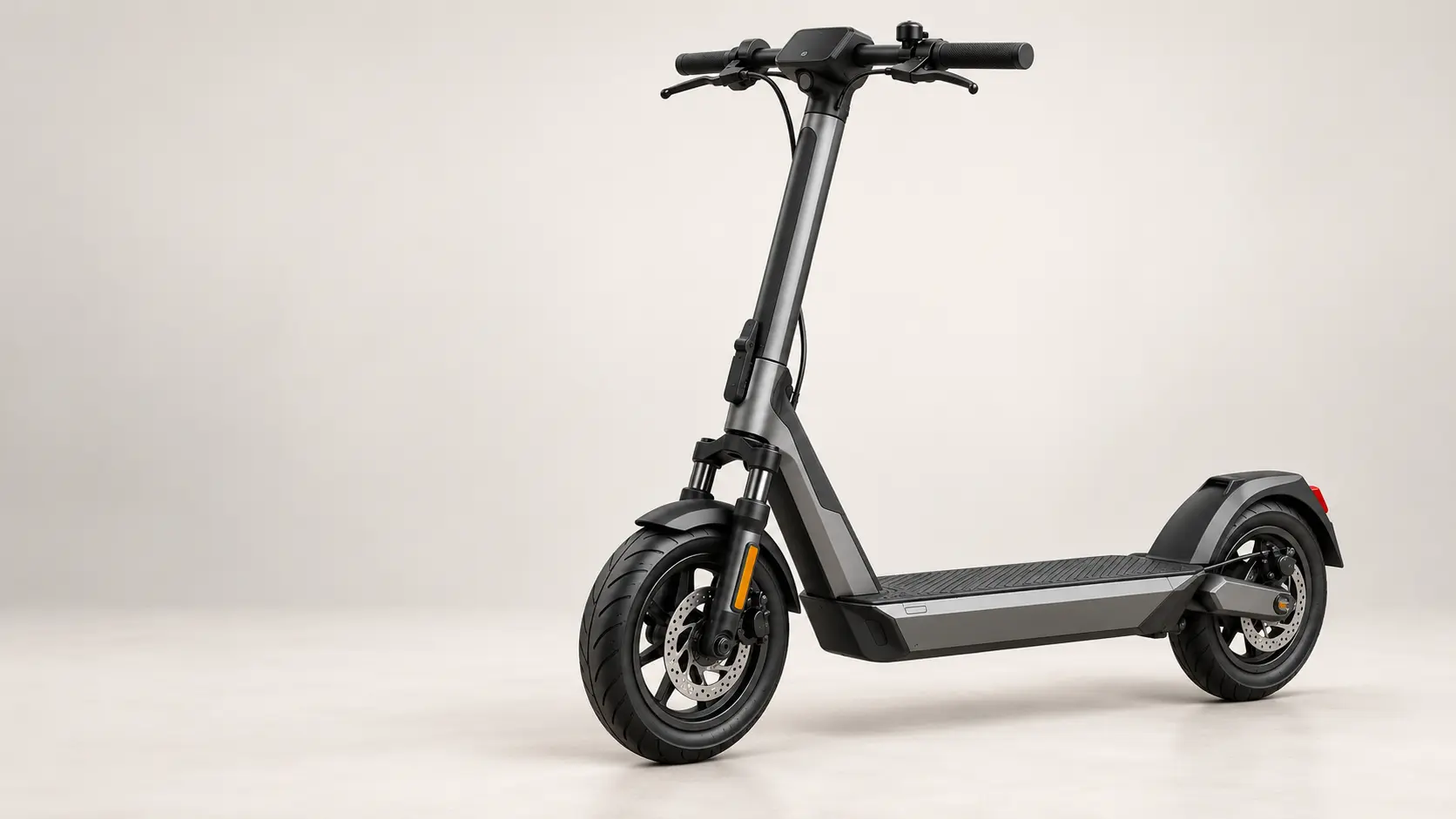
Original studio-style illustration based on the NIU KQi 300X design; check the manufacturer or seller for exact product photography and finish.
Disclosure: TheScooterist may earn a commission when you use a qualifying Amazon link. The recommendations are an editorial comparison of published specifications and independent testing—not a claim that our team personally road-tested every model. Amazon buttons lead to model-specific search results because seller listings and variants can change.
Short answer: For a balanced ride on mixed city pavement, start with the NIU KQi 300X. If you need to carry your scooter every day, the 26.2-pound NIU KQi Air changes the equation. Want stronger suspension without paying flagship money? Compare the NAVEE GT3 Pro with the Segway E3 Pro. And if your route is long and you rarely lift it, the Segway MAX G3 Plus belongs on the shortlist.
These are manufacturer specifications for the named US versions—not independently measured results. Pay particular attention to weight and suspension: you experience those every day.
Maximum ranges were published under different test speeds, rider loads and conditions. Do not treat the numbers as a head-to-head real-world range test. Verify variant selection—especially VMAX LT/ST/GT and GOTRAX G4 versus G4 Pro.
How much range do you actually need?
Enter your one-way distance. The calculator doubles it for the round trip and adds a 25% planning buffer. This is a conservative shopping aid, not a prediction of a scooter's tested range.
For a 10-mile round trip, target a comfortably achievable range of at least 12.5 miles.There is no single reliable conversion from a maker's Eco-mile claim to your commute. Seek independent testing under similar conditions and plan extra reserve.
Seven commuter scooters worth comparing
Each pick has a specific job. A heavier scooter with plush suspension might be excellent on a 10-mile route and a terrible choice for a fourth-floor walk-up. The trade-offs below matter more than a star score.
The KQi 300X makes sense for a commuter whose road includes broken asphalt, moderate hills and stop-start traffic. The front hydraulic fork absorbs impacts that a completely rigid scooter sends into your wrists, while the wide deck and 10.5-inch tires give your feet more usable room. NIU lists dual mechanical disc brakes plus regenerative braking and integrated turn signals.
The catch is not performance; it is weight. At 48.7 pounds it folds, but you will notice every stair. NIU's 37.3-mile figure is its maximum laboratory-style range claim, and the US product listing caps on-road speed at 20 mph; don't mistake an advertised peak motor output or an overseas speed setting for legal US-road performance.
Choose it if: Your ride is mostly on city streets and you can store the scooter on the ground floor. Skip it if: You commute with multiple staircases or require front and rear suspension.
Most commuter guides underrate carrying weight. If you take a train, lift your scooter into a trunk, or carry it up stairs, the KQi Air's 26.2-pound weight is a major practical advantage over the 40–56-pound machines here. NIU still gives it 9.5-inch tubeless tires, a 451.2-Wh battery, turn signals and a full-size deck rather than a tiny travel-toy format.
But the premium weight saving costs money, and it has no conventional suspension. More importantly, lightness does not make a scooter compact in every direction: measure the folded length and handlebar width before assuming it will fit between train seats. Its 31-mile range is a claimed maximum, not a promise for full-speed traffic riding.
Choose it if: Getting the scooter indoors is as important as the ride itself. Skip it if: Your streets are deeply potholed and your commute does not require frequent lifting.
Trade-off: The lightest option in this group by a wide margin, with limited bump absorption compared with full-suspension models.
03
Best premium option for long routes
Segway Ninebot MAX G3 Plus
About 56 lb56-mi Eco claim28-mph rated maxDual hydraulic suspension
The MAX G3 Plus is the pick for someone whose scooter replaces a meaningful slice of car travel. The front and rear hydraulic suspension, larger battery and substantial platform are more relevant to a long trip than another few mph of headline speed. Segway lists up to 56 miles in favorable Eco conditions and about 56 pounds of curb weight.
This is also the clearest reminder not to shop by the maximum range alone. Car and Driver measured 19 miles while using Sport+ mode in its testing—a different riding regime, not proof of a defective battery. Your actual distance depends on mode, weight, grades and temperature. The G3 Plus is substantially bulkier than a last-mile commuter, so ensure your destination has appropriate storage. Its 28-mph capability may exceed local rules; use an allowed mode and check your city restrictions.
Choose it if: You have secure ground-level parking and value ride comfort over lifting convenience. Skip it if: You regularly need to haul the scooter on transit.
Trade-off: High comfort and long-distance capability, paired with premium cost and a 56-pound carry penalty.
04
Best rough-pavement comfort value
NAVEE GT3 Pro
48.5 lb37 mi at 9 mph / 22 mi at 20 mphFront + rear suspensionIPX5
The GT3 Pro is unusually straightforward about range conditions: NAVEE states roughly 37 miles at 9 mph versus 22 miles at 20 mph. That's the kind of honest context commuters need. A front fork and rear cylinder suspension, 10-inch tubeless tires and a generous deck make this a sensible candidate when city pavement is uneven.
The compromise is the same as with other comfort-oriented models: a nearly 49-pound machine is still a heavy lift. Manufacturer charging time is around eight hours, which makes overnight charging practical but reduces your flexibility if you forget before work. The 20-mph top speed is more than adequate for many shared paths, subject to local restrictions.
Choose it if: Your route includes repeated cracks, seams and imperfect asphalt. Skip it if: You have to move the scooter between floors several times a day.
Trade-off: The full-suspension setup suits imperfect surfaces, but weight and charging time are less friendly to mixed-mode commuting.
05
Best compact everyday value
Segway Ninebot E3 Pro
40.1 lb34 mi Eco / 17.5 mi Sport claim20 mphIPX5
The E3 Pro offers a useful middle ground: genuine front and rear elastomer shock absorbers, 10-inch tubeless tires and a 40.1-pound folding frame without the bulk of Segway's flagships. Segway's US manual gives unusually helpful ranges by speed mode: about 34 miles in Eco, 25 miles in Drive and 17.5 miles in Sport under the manual's specified test load and pavement conditions.
Those elastomer absorbers won't behave like the hydraulic systems on a larger machine, and the 7-hour charging time needs planning. But for a modest commute on decent pavement with occasional rough patches, it avoids paying for capability that may never be used.
Choose it if: Your commute is relatively short, you value a familiar brand and you can carry 40 pounds when necessary. Skip it if: You need frequent stair carries or sustained long-distance Sport mode.
Trade-off: Well-chosen everyday hardware, but significantly shorter claimed range in Sport than Eco and a fairly long charging window.
06
Best straightforward budget option
GOTRAX G4
37 lb25-mi lower-speed claim20 mphIPX4
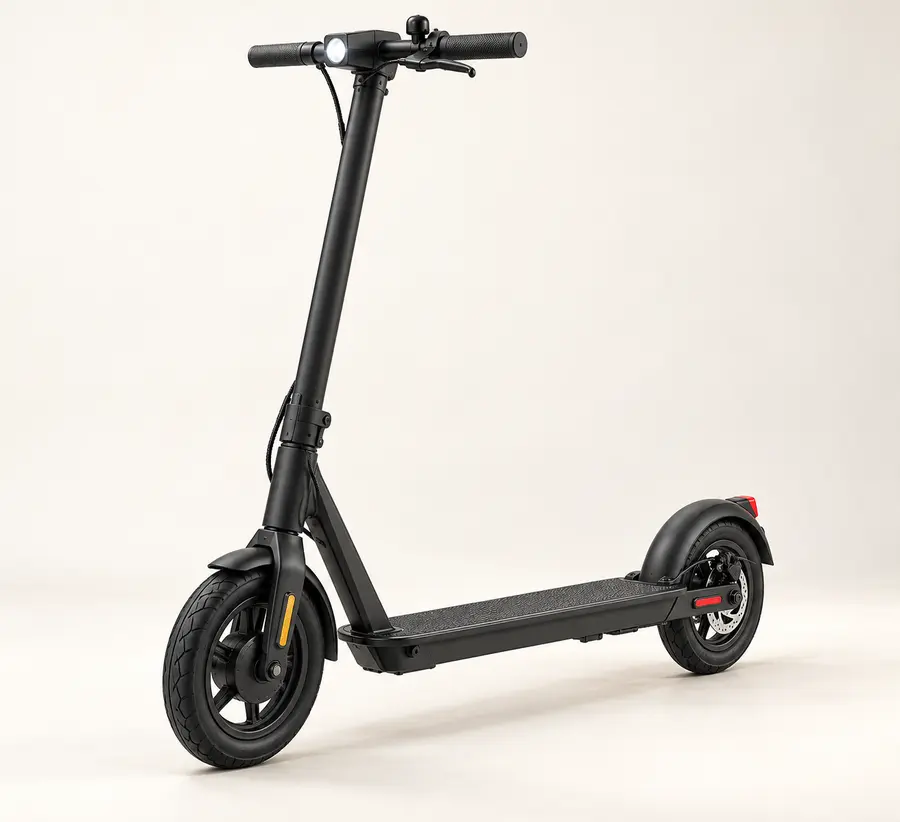
If your commute is predictable and the road surface is decent, the G4 keeps things simple. GOTRAX lists 37 pounds, a folding frame, a 500-watt motor, a lock integrated into the scooter and a 20-mph maximum speed. The brand makes the range limitation clear in its speed-mode details: up to 25 miles in the lower gear, but up to 15 miles at the faster 20-mph setting.
Be careful with the model selector. The standard G4 and the G4 Pro differ in wheel and suspension hardware; the Pro version adds front suspension. The standard version has no suspension and has an IPX4 water-resistance rating, so it is not our recommendation for frequent rain or broken surfaces.
Illustrative G4-style product image. Inspect the selected seller variant for exact tire and brake details.
Choose it if: You want uncomplicated point-to-point transport on smooth pavement. Skip it if: Rough roads, rain exposure or high-speed range are major concerns.
Trade-off: Lighter and simpler than suspension-equipped commuters, but full-speed range can be much shorter than the advertised headline.
07
Best lighter smooth-road option
VMAX VX5 Pro GT
36.8 lb (GT)Up to 25 mi (seller listing)17 mphIPX6
The VX5 Pro GT is a practical counterpoint to the big, heavy 28-mph machines. At 36.8 pounds with 9-inch tubeless tires, bright lighting, front drum braking and IPX6-rated protection, the scooter puts manageability and everyday details first. Its official US page lists a 17-mph top speed, which is not thrilling—but plenty for many first- and last-mile rides.
There is one important purchase trap: VMAX sells LT, ST and GT battery versions, and the GT is the long-range variant discussed here. Don't assume the lightest LT's battery matches the GT's. Its rigid suspension-free design also makes it a better candidate for maintained streets than a badly patched city route. VMAX notes its range depends on rider weight, speed and level terrain.
Choose it if: You want less weight and don't need speed above 17 mph. Skip it if: You're battling deep potholes or want powerful suspension.
Trade-off: Easygoing speed and lower weight, but don't mistake the GT battery for smaller LT/ST versions.
The number that can change your commute: carry weight
Here's the manufacturer's complete-scooter weight for the seven listed variants. This isn't a performance ranking—the shortest bar is simply easier to lift. Think about a 20-step staircase and a backpack before deciding that a few extra miles of claimed range will solve your problem.
Carry weight comparison (pounds)
NIU KQi Air
26.2
VMAX VX5 Pro GT
36.8
GOTRAX G4
37
Segway E3 Pro
40.1
NAVEE GT3 Pro
48.5
NIU KQi 300X
48.7
Segway MAX G3 Plus
~56
Original chart based on published model weights (October 2026). Approximate values retain manufacturer rounding. Bars are scaled relative to 56 lb—not an independent measurement.
How to choose for the route you actually ride
Range: budget for speed, not Eco marketing
Maximum distance claims are often recorded at modest speed with a light rider and favorable conditions. The same scooter may travel far less in its fastest mode; compare NAVEE's 37 miles at 9 mph with its 22 miles at 20 mph, and Segway E3 Pro's 34-mile Eco versus 17.5-mile Sport figures.
Storage: folded is not the same as portable
A 50-pound scooter still weighs 50 pounds when folded. Check folding-latch security, folded dimensions, office policies, bike-rack restrictions and whether your transit system accepts scooters.
Pavement: tires and suspension work together
Tubeless pneumatic tires smooth smaller texture; suspension helps with more abrupt bumps. Always keep tire pressure within the manufacturer's range. Solid tires often simplify puncture care but can transmit more vibration.
Water: IP ratings are not a rain warranty
IPX4, IPX5, IP55 and IPX6 describe different tested levels of ingress protection. None means waterproof for immersion, nor automatically makes riding on wet pavement safe. Braking grip, visibility and the seller's warranty matter.
Hills: look past peak watts
Steep grades need sustained motor output and thermal management. Check independent hill tests with a rider near your weight rather than comparing peak-watt stickers from different brands.
Repair: ask before something breaks
Find out how you can replace tires, brake parts and batteries, where warranty work happens, and whether a local service shop supports the model. Start with our electric scooter repair directory.
The five-minute pre-purchase checklist
Measure your trip: count the round-trip miles and set a buffer, rather than picking the largest headline range.
Try a carry test: imagine lifting the scooter's listed weight through every unavoidable staircase.
Look at your street: hills, potholes, curbs and frequent rain can change your choice more than top speed.
Check legal and transit rules: speed limits and permitted riding areas vary by city, state and operator. Higher rated speed does not mean that speed is lawful on your commute.
Check exact variant and support: confirm the model's tires, suspension, battery version, certification and seller warranty before paying.
For a broader look at models that work for leisure riding as well as transportation, see our electric scooters for adults guide. If a scooter isn't charging properly, our interactive troubleshooting hub can help you narrow down the symptoms before visiting a repair shop.
Commuter scooter questions, answered
How many miles of range do I need for a 5-mile commute?
If that is five miles each way and you don't recharge at work, plan for at least 10 miles per day plus a reserve. The calculator above suggests a 12.5-mile usable target with a 25% buffer. An advertised 12.5-mile maximum is not the same as 12.5 miles at your riding speed and on your terrain.
Is a 40-pound scooter too heavy to commute with?
Not necessarily—if you roll it into ground-floor storage. A single flight of stairs every day is a different situation. Try lifting a similarly weighted object repeatedly and think about folded size before buying.
Which commuter scooter is best for bumpy roads?
Among these picks, the NAVEE GT3 Pro and Segway MAX G3 Plus offer front and rear suspension. The NIU KQi 300X has a front hydraulic system. Correctly inflated pneumatic tires also make a difference.
Can I commute in the rain on an IP-rated scooter?
A published IP rating describes standardized water-resistance testing, not an invitation to ride in heavy rain. Braking distances, traction and visibility worsen on wet surfaces; follow the model's actual operating and warranty guidance.
Why are Amazon listings sometimes different from the comparison table?
Model names often include multiple versions, regional speed settings, battery sizes and sellers. Our Amazon links intentionally show a search for the exact named model; verify the listing matches the specifications above before ordering.
Specifications and external testing
The manufacturer links in each model section are the source of its specifications. For context on real-world performance, we also reviewed Car and Driver's independent scooter roundup and ERideHero's commuter testing. These tests use different methods and shouldn't be directly combined into a single ranking.
Our bottom line: If you only remember one thing, choose for your whole journey—especially the part after you stop riding. The KQi 300X is a strong overall starting point, but the KQi Air is the better answer when stairs or public transit dominate the trip.